Your Manual Operating Model Is Now Your Biggest Risk
Life sciences organizations are under pressure to move faster, reduce compliance cost, and strengthen inspection readiness — without proportional increases in headcount.
Meanwhile, AI capabilities are already embedded inside the platforms you own. The question isn't whether to adopt AI. It's whether you're activating what's already available — responsibly, defensibly, and at scale.
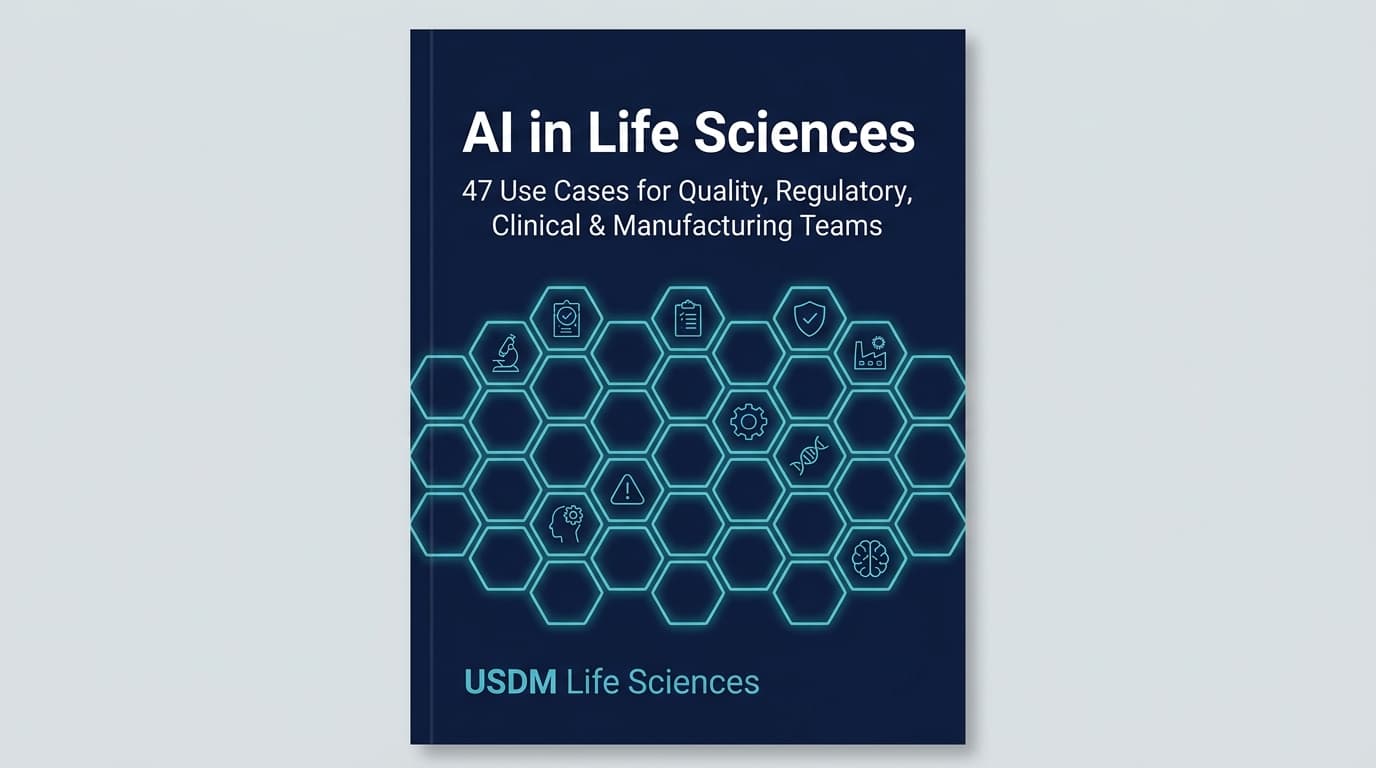
This white paper maps 47 concrete AI use cases across eight regulated domains, with quantified outcomes and inspection-aware architecture — so you can move from pilot to production with confidence.
Regulatory agencies are no longer asking if you use AI. They're asking how you govern it. Organizations that move early — with defensible architecture and validated workflows — will set the standard. Those that wait will inherit someone else's framework.
What's Inside
8 Domains · 47 Use Cases · 3 Maturity Levels
- Quality & Compliance — Deviation triage, CAPA root cause, audit prep, supplier qualification
- Regulatory Affairs — Submission readiness, labeling impact analysis, health authority intelligence
- Clinical Operations — TMF quality intelligence, CRO oversight, protocol deviation detection
- Manufacturing & Supply Chain — Batch record review by exception, predictive maintenance, supply disruption
- Safety & Pharmacovigilance — Case intake automation, narrative drafting, signal detection
- Medical Affairs — MLR acceleration, KOL mapping, medical information response
- Cybersecurity — Threat classification, GxP system monitoring, identity governance
- Corporate Functions — Contract analysis, knowledge management, onboarding acceleration
Each use case includes an AI maturity progression — from assistive automation to generative reasoning to predictive intelligence — so you can plan adoption in phases.
Who This Is For
- Quality & Compliance: CQOs, VPs of Quality managing deviations, CAPAs, and inspection readiness
- Regulatory Affairs: VPs of RA navigating submission complexity and labeling
- Clinical Operations: VPs of Clinical Ops overseeing TMF and CRO performance
- Manufacturing & Supply Chain: SVPs of Ops tackling batch review and supply disruption
- Safety & Pharmacovigilance: Heads of PV facing 8–12% annual case volume growth
- Medical Affairs: Leaders managing MLR cycles averaging 4–6 weeks with 30%+ rework
- CIOs, CTOs & Chief AI Officers: Evaluating AI through the lens of operational impact
The Numbers That Matter
| Domain | Impact |
|---|---|
| Quality | 30–50% faster deviation triage |
| Manufacturing | 50–80% reduction in batch record review |
| Safety & PV | 50–70% reduction in narrative drafting |
| Regulatory | 20–35% faster submission readiness |
| Medical Affairs | 25–35% reduction in MLR review cycle time |
| Clinical | 30–50% reduction in manual TMF QC |
Outcomes are based on USDM client engagements and domain benchmarks. The white paper includes detailed methodology and context for each figure.
Why USDM
USDM Life Sciences partners with regulated organizations to embed intelligent automation into existing enterprise platforms — reducing compliance cost, accelerating execution, and remaining defensible under inspection.
What You Get
- 47 use cases mapped across 8 regulated functional domains
- Buy vs. Build vs. Augment framework for evaluating platform-embedded AI vs. custom development
- 6 deep dives — inspection readiness, batch record review by exception, TMF quality intelligence, labeling impact analysis, case processing, and MLR review
- Inspection-ready architecture — multi-agent system designs with human-in-the-loop governance and full audit trails
Contributors: John Petrakis (Chief AI Officer), Hovsep Kirikian (VP Strategy & Operations), Mark Ohrvall (VP Delivery Operations), Lisa Om (VP Marketing & Communications), Brian Rankin (Head of Cybersecurity Services), Jennell Botero (Principal Consultant), Brittany Walker (Principal Consultant). Learn more about USDM leadership and experts on the people page.
Watch the USDM Summit On-Demand
This white paper is part of a broader conversation on how life sciences organizations can move from AI intent to inspection-ready impact.
At the USDM Life Sciences Summit 2026, industry leaders, practitioners, and regulators explored these use cases in greater depth — sharing real-world lessons, architectural patterns, and governance approaches that work in regulated environments.
If this dossier resonates with your current challenges, the Summit is where strategy becomes execution. Watch on-demand now.